Healthcare AI research moves slowly for a good reason: every useful idea has to survive evidence review, clinical context, and patient-safety questions before it can influence care.
SmartClover's healthcare AI work is anchored in cervical-screening and follow-up questions. We use published research to understand where screening pathways break down, what teams need to review, and which workflow steps should stay visible to clinicians.
Two public references are especially useful:
- PubMed 28460211 documents qualitative research on participation in cervical cancer screening among Roma women in Romania.
- PubMed 35197342 describes a BMJ Open study protocol on barriers and facilitators to follow-up after abnormal cervical screening results in remote Romanian communities.
These sources do not prove product performance. They help define the operating questions behind CerviGuard: intake, review, triage coordination, and clinician-led follow-up.
Large language models can support research work when the task is bounded: literature review, note organization, hypothesis drafting, retrieval over approved source material, or preparation of review packs. That support should stay clearly separated from diagnosis, treatment direction, or clinical evidence about product performance.
The rule is simple: research support is not clinical instruction.
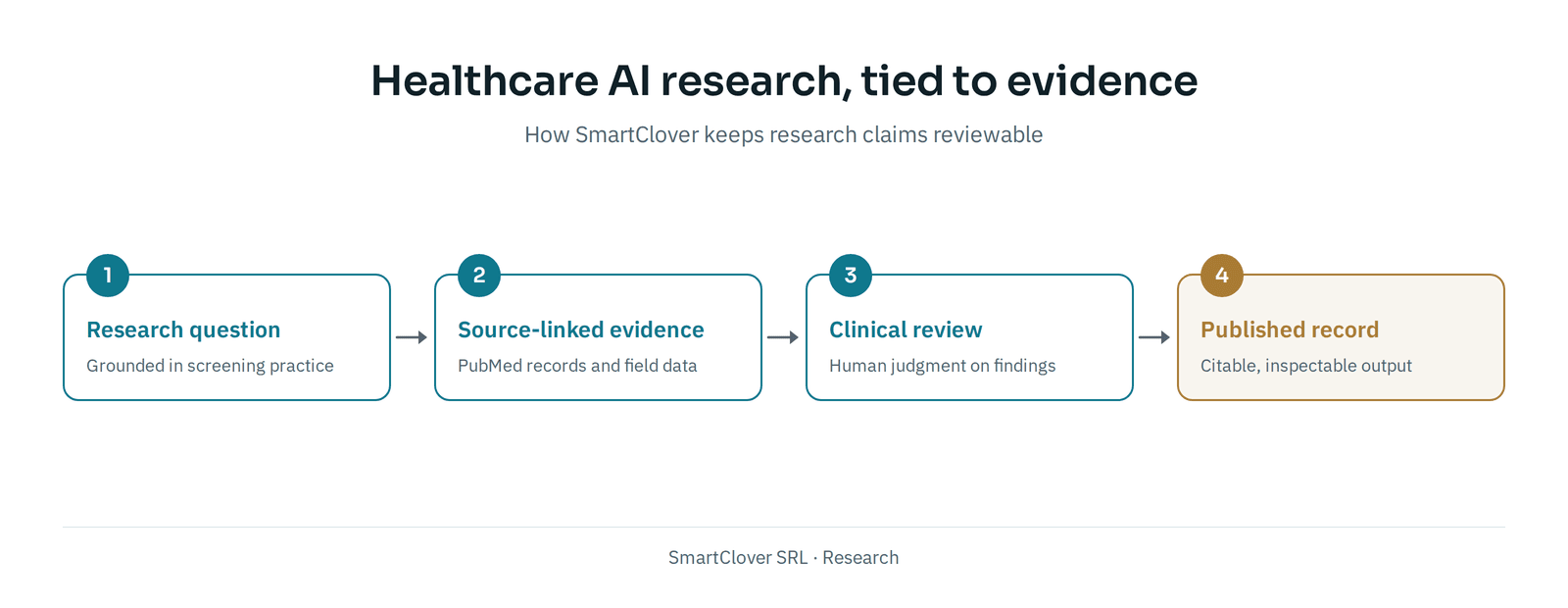
Any AI-supported research workflow we publish should produce output a clinician, researcher, or reviewer can challenge. Where did the statement come from? Which source supports it? What is missing? What should remain a human judgment?
That is also why DataGems supports research preparation work. Synthetic examples can help teams rehearse schemas and pipelines before sensitive data is appropriate, but they do not replace real-world clinical evidence.
For SmartClover, responsible healthcare AI research means keeping source material, model output, workflow decisions, and human review close enough that a team can inspect the path from question to next action.
Last reviewed: 2026-05-11.